This article may contain affiliate links. If you buy through them, Everyday Nesting may earn a small commission at no extra cost to you. Learn more.
For most of the spring, my living room shelves had a problem I could not name. They were not messy exactly. Everything on them had a purpose and a place. But the whole wall felt heavy in a way that made the room smaller than it actually was. It took me embarrassingly long to realize the issue was not what was on the shelves, it was how little space I had left between things.
The Instinct to Fill Every Gap
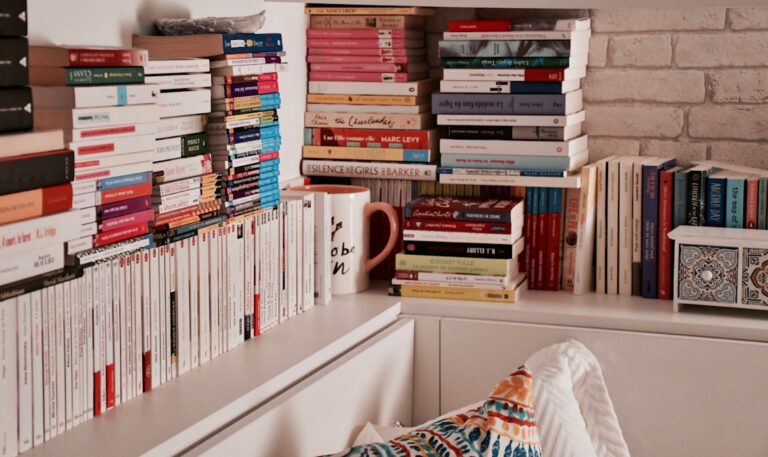
I think there is a natural pull, at least for me, to treat empty shelf space as unfinished space. Every time I noticed a bare patch, I found something to put there. A small frame here, a candle there, a stack of coasters in a spot that had been open for exactly one afternoon before I decided it needed something. Looking back at photos from that period, every single shelf is full edge to edge. Nothing has room to be looked at on its own.
What overcrowding actually does to the eye
When a shelf is completely full, the eye has nowhere to land. It scans across the whole thing looking for a place to settle and does not find one, so the impression is just clutter, even if each individual object is something I actually like. I did not understand this until I did the opposite experiment out of frustration one weekend.
The Weekend I Removed Almost Everything
I pulled about sixty percent of the objects off the main shelf and put them in a box in the closet, telling myself I would add back only what the shelf actually needed. What was left was three objects across four feet of shelf. It felt like a huge relief for about two days. Then it started to feel cold, like a shelf in a house nobody actually lived in. The negative space had gone from a tool to the entire point, and that swung too far in the other direction.
Finding the Actual Ratio
What I landed on after bringing some of the boxed items back, one or two at a time over a couple weeks, was something closer to leaving a third of the shelf visually open at any given moment. Not literally measured, but if I squint at the shelf, roughly a third of the horizontal space should read as breathing room rather than object.
- Group objects into two or three clusters instead of spacing everything evenly across the whole shelf
- Leave the largest gap next to the tallest or busiest cluster, so that grouping has room to be the focal point
- Smaller gaps between the remaining objects are fine, the goal is one or two clear pauses, not even spacing everywhere
- Check the shelf from across the room, not just standing in front of it, since crowding reads differently at a distance
The empty space is not the absence of decorating. It is doing as much work as the objects are, it just does it by making the objects around it easier to actually see.
Different Shelves Wanted Different Amounts
The living room shelf settled at that roughly one third open ratio, but my kitchen open shelving wanted much less empty space to feel right, closer to filled with only small gaps between stacks of dishware. I think that is because the kitchen shelves are doing double duty as storage, so a mostly full look reads as functional rather than cluttered. The bedroom bookshelf, on the other hand, wanted more open space than the living room did, closer to half, because books already create a dense visual texture on their own and needed more room around them to avoid feeling like a wall of spines.
What I Check Now
Before I add anything new to a shelf, I ask whether the object is filling an actual gap that needs breaking up, or whether I am just uncomfortable with the shelf having a quiet section. Most of the time now it is the second one, and most of the time the right answer is to leave the gap alone. It took a full shelf and then an empty one to figure out that the negative space was never a problem to solve, it was a measurement I had never bothered to pay attention to before.
A Trick That Helped Me Stop Second Guessing It
For a while I still caught myself hovering near a shelf with some small object in hand, unsure whether a gap needed filling or not. What finally settled most of those moments was walking away from the shelf for a full day before deciding anything. If I passed the shelf a dozen times over that day and the gap never bothered me once, that told me more than staring at it up close ever did. The gaps that actually needed something were the ones I kept noticing on the way past, not the ones I only questioned while standing directly in front of them with a candle in my hand looking for somewhere to set it down.
What Surprised Me Most
The part I did not expect going into any of this was how much the empty space changed how I felt about the objects that stayed. The three pieces I kept on the overstuffed version of the living room shelf were the same three pieces that ended up as the anchor of the final version, but they read completely differently once they had room around them. Nothing about the objects changed. Only the space around them did, and that alone was enough to make the whole shelf feel considered instead of accumulated, which is really what I had been trying to get to since the very first crowded attempt back in the spring.