This article may contain affiliate links. If you buy through them, Everyday Nesting may earn a small commission at no extra cost to you. Learn more.
On day three of my last move, I spent almost fifteen minutes looking for my keys in a stack of flattened moving boxes by the front door, because I had set them down somewhere in that pile the night before and had no system for where “somewhere” actually was. That fifteen minutes is what finally got me to set up an entryway drop zone before I had unpacked almost anything else in the apartment.
Why this usually gets skipped in the first week
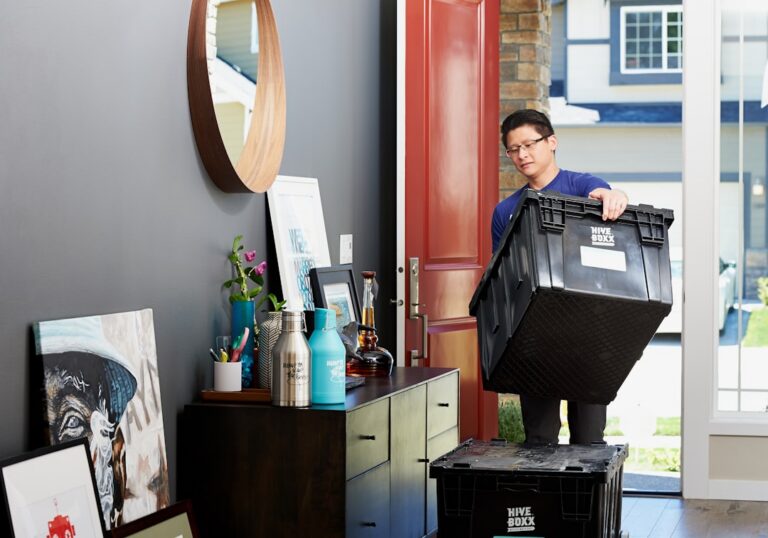
An entryway system feels like a finishing touch, the kind of thing you add once the real unpacking is done: a hook here, a small tray there, maybe a bench eventually. Because it feels decorative rather than functional, it tends to get pushed to the bottom of the list, behind the kitchen, the bedroom, the bathroom, all the rooms that seem more urgent. But the entryway is the one spot in the apartment that gets used the most times per day during the actual move, since every trip in and out, every armload of boxes, every trip to the car for one more thing, passes through that exact spot.
By the time I realized this, the front door area of my apartment had become the default landing spot for anything I was not sure where else to put: mail, a jacket, a phone charger, the keys that started this whole thing. It was not chaos by choice. It was chaos by default, because nothing else had been assigned to that space yet.
What I set up, and how fast it worked
The fix took about twenty minutes and used things I already owned: a single adhesive hook for keys, mounted at the height where my hand naturally landed when reaching for the door, and a small bowl, the kind meant for fruit, set on top of a stacked pair of moving boxes that were serving as a temporary table anyway. Keys went on the hook. Mail and anything else small went in the bowl. That was the entire system.
- One hook for keys, at hand height, not eye height
- One shallow container for mail and small loose items
- A spot on the floor, even just a corner, designated for shoes, so they stop ending up in the middle of the walkway
- Nothing else, at least not yet
Within two days the habit had already formed. Keys went on the hook without me thinking about it, mostly because the hook was right there and using it took less effort than setting keys down anywhere else.
Why the temporary version worked as well as it did
What I noticed, looking back, is that the actual furniture, a proper console table, a mounted key rack, a bench with storage underneath, was not what solved the problem. The hook and the bowl solved it, on day three, for close to nothing in cost or effort. The nicer furniture arrived almost two months later and made the entryway look more finished, but it did not change the underlying habit at all, because the habit had already formed around the simple version.
The thing that stops the daily key hunt is not a good looking entryway. It is having exactly one obvious place for keys to go, set up before the habit of losing them has a chance to form.
The mistake I made in a previous apartment
In the apartment before this one, I waited on the entryway entirely, assuming it would sort itself out once the rest of the unpacking was done. It never quite did. Even a year in, I had a loose habit of setting keys down on whatever surface was closest, which meant the kitchen counter, the arm of the couch, occasionally the top of the refrigerator for reasons I never figured out. Without an early, obvious system, no single spot ever won out, and I kept losing five minutes here and there indefinitely, not just in the first week.
Setting it up before the boxes even leave
The version of this I would recommend now is doing it on the same day the movers leave, before the boxes are broken down, before the rest of the apartment has any system at all. It does not need to be nice. It does not need to match anything. It needs to exist, in one consistent spot, before the habit of dropping things randomly has a chance to take hold, because once that habit forms in the first week, it tends to stick around a lot longer than the boxes do.