This article may contain affiliate links. If you buy through them, Everyday Nesting may earn a small commission at no extra cost to you. Learn more.
The bookshelf in my bedroom has been rearranged four separate times this year, and I mean fully emptied and rebuilt, not just a book or two shifted around. Each time I convinced myself I had finally solved it, and each time something about daily use wore the arrangement down until I could not stand it anymore. This is the record of what went wrong at each stage and what I settled on.
Attempt One: Everything Spine Out, Organized by Author
This was the version that made the most sense on paper. Spines out means I can actually read the titles, and alphabetizing by author means I can find a specific book when I want it. In practice it looked like a library shelf that had wandered into my bedroom. Every book was the same orientation, the colors clashed with no logic behind them, and the top of the shelf, which I had left completely bare for books, felt like it belonged in an office rather than a bedroom I actually spend time in.
Attempt Two: Color Blocked, Grouped by Spine Tone
I went to the opposite extreme after seeing this style everywhere. Every book sorted by the color of its spine, moving from warm tones on one end to cool tones on the other. It looked striking from across the room for about a week. Then I needed a specific book on hospice care I had bought for a family situation, and I stood in front of that shelf for ten minutes scanning colors instead of titles because I had completely lost track of where anything actually was. A shelf that only works as a photograph and not as a place to find your own books is not actually doing its job.
The real problem was treating it as one system
What both of those attempts had in common was applying a single rule to the entire shelf, top to bottom, left to right. Alphabetical everywhere, or color everywhere. Neither one left room for anything to just look nice or to actually be used the way I use books day to day.
Attempt Three: All Stacked Flat
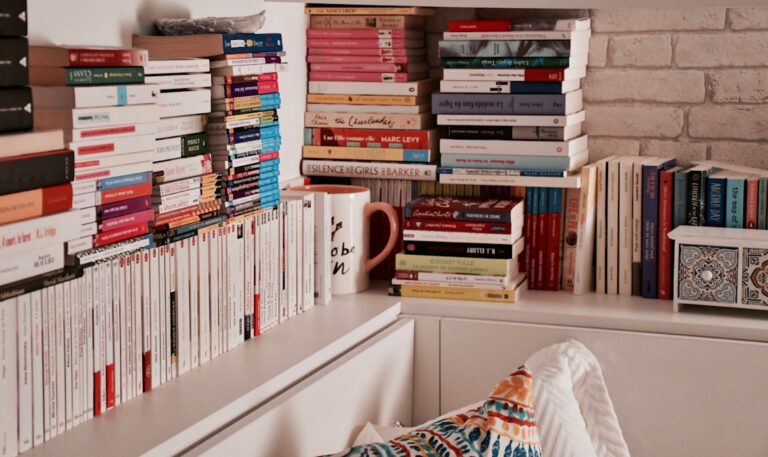
After the color fiasco I overcorrected again and stacked almost every book flat in horizontal piles with small objects on top of each stack. This one looked calm and layered in photos, but it made the books themselves nearly impossible to use. Every time I wanted something from the middle of a stack I had to lift four other books off first, and the stacks kept sliding when I did. Books I actually reread often ended up buried at the bottom of piles I had built for how they looked from the doorway.
What I Actually Do Now
The shelf that has finally stuck for more than two months mixes all three approaches, but by section rather than uniformly. The books I reach for most, a handful of paperbacks and a couple of reference books, sit spine out on the middle shelf, at roughly eye level when I am sitting on the bed, grouped loosely by subject rather than strict alphabetical order. The top shelf, which is harder to reach and holds books I rarely pull down, is where I let color and stacking take over, since browsing by touch matters less up there than it does at eye level.
- Frequently used books go spine out at the most reachable height, organized loosely by what they are about rather than a strict system
- Rarely used or purely decorative books go higher or lower, where stacking and color grouping do not get in the way of daily use
- A few flat stacks with a small object on top break up the vertical spine lines, but only two or three stacks total, not the whole shelf
- One section left with visible gaps, not packed edge to edge, so the eye has somewhere to rest between groupings
The shelf works now because I stopped asking it to be one thing. Part of it is for finding books quickly. Part of it is just for looking at. Those are different jobs and they wanted different rules.
The Detail That Finally Fixed It
The last adjustment, the one that made the whole thing feel finished, was leaving a gap of a few inches at one end of the eye-level shelf instead of pushing every book flush to the side. That gap gives the row of spines somewhere to end visually instead of just running into the shelf’s edge, and it also gives me a spot to slide a new book in without having to shift the entire row every time I bring one home. Small thing, but it is the one change across four rebuilds that I have not second guessed since.