This article may contain affiliate links. If you buy through them, Everyday Nesting may earn a small commission at no extra cost to you. Learn more.
My apartment came with a stretch of laminate flooring in the living room that is the color of weak tea, and it does not match anything I own. I could not replace it, obviously, so for the first year I just lived with it and complained about it to anyone who would listen. Then I decided to actually solve the problem instead of talking about it.
The first rug was too small
I bought a 5 by 7 foot rug because it was on sale and I did not measure anything first. Once it was down, it looked like a stamp in the middle of the room, with a wide border of the ugly floor still showing on every side. It made the room look smaller, not better. I lived with that mistake for about four months before I admitted it was not working.
The lesson from that round was simple: a rug that is supposed to hide flooring has to be sized for the furniture layout, not for the room. If your couch and chairs sit on the rug, the rug needs to extend under the front legs of each piece, or at least close to it. Anything smaller reads as a mat, not a floor treatment.
The second attempt was the right size but the wrong color
For the second try I measured properly and got an 8 by 10 foot rug. Size was right this time, but I picked a pale oatmeal color because I liked it in the online photo. In the room, next to that tea colored laminate, the oatmeal rug picked up a strange yellowish cast from the floor showing at the edges. It was not a disaster, but it was not the calm neutral I had pictured either.
What I learned here is that when you are trying to visually cancel out a floor color you do not like, the rug should either contrast clearly with it or lean into a tone that sits further away on the color wheel. A warm tea colored floor needs a rug with some gray or blue undertone to read as separate from it, not a rug in the same warm family that just blends and muddies.
The third rug, plus a trick I did not expect to need
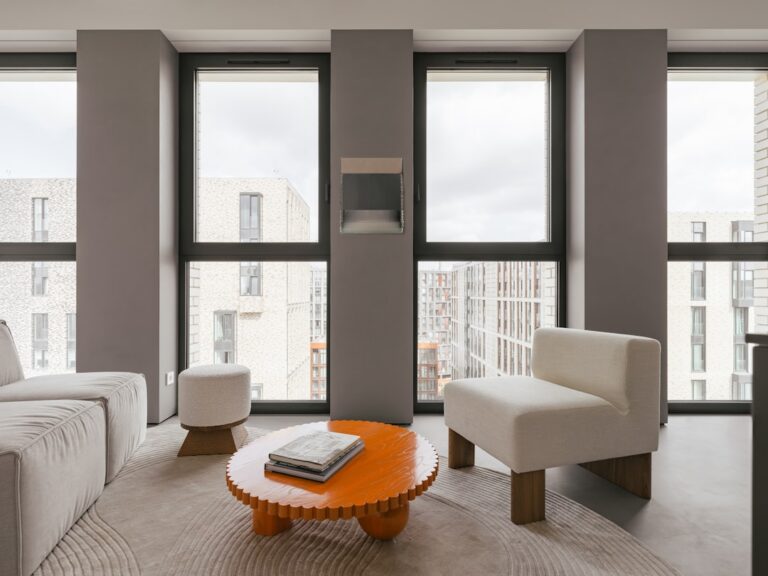
The rug that finally worked was a charcoal gray, still 8 by 10, with a low pile so it would not trap dust in a way that bothers my cat. That solved most of the visual problem. But there was still a foot or so of exposed flooring between the rug and the baseboards on two sides, since the room is not a perfect rectangle.
For that remaining strip, I did not want to buy peel and stick tiles, since I was not confident I would get a full deposit back if the adhesive left marks, and my lease is specific about not altering the flooring. Instead I used a runner along the one wall where the gap was widest, tucked so it would not curl at the edges, and left the narrower gap on the other side alone. It turned out that once the large rug anchors the room, a small amount of visible floor at the margins stops registering as a flaw. Your eye follows the big shape, not the edges.
The floor did not change. What changed is how much of it you actually see at once, and that turned out to matter more than I expected.
What I would tell myself before buying the first rug
Measure the seating area first, including where chair legs land, and add at least a few inches of rug on every side of that footprint. Choose a color that separates from the floor tone rather than one that merges with it, even if the merging color is the one you would pick in a vacuum. And before spending money on adhesive-based covers, check your lease. Mine has language about flooring alterations that I did not read carefully until after I had already ordered peel and stick samples I ended up not using.
Other rental floor problems that come up in the same room
Once the main rug was settled, a few smaller issues showed up. The transition strip between the living room and the hallway is a plain aluminum bar that catches light in a way I do not love. I have not solved that one yet. I also have a spot near the kitchen doorway where the laminate has a slight lift, not damaged, just a little proud of the surrounding boards, and I keep a small low profile mat there mostly so nobody catches a toe on it.
None of this required permanent changes. The rug does the heavy lifting, a runner covers the worst remaining gap, and a small mat handles a minor safety issue near the doorway. If I move out, all three items come with me, and the floor underneath is exactly as it was when I moved in, tea colored laminate and all.
If your rental has a floor you cannot stand
Start with the size question before anything else. I wasted four months on a rug that was the right idea in the wrong dimensions. Get the measurements of your seating footprint, add margin, and only then start thinking about color and texture. It is a slower way to shop, but it means you buy the rug once instead of three times, which is more than I can say for myself.