This article may contain affiliate links. If you buy through them, Everyday Nesting may earn a small commission at no extra cost to you. Learn more.
I used to think curtains were mostly about color and pattern, the part you pick from a swatch card standing in a store aisle. It took hanging three completely different panels in the same living room window, over about two months, to understand that weight and drape do almost all of the actual work. The pattern is just decoration on top of a decision that happens at the fabric level.
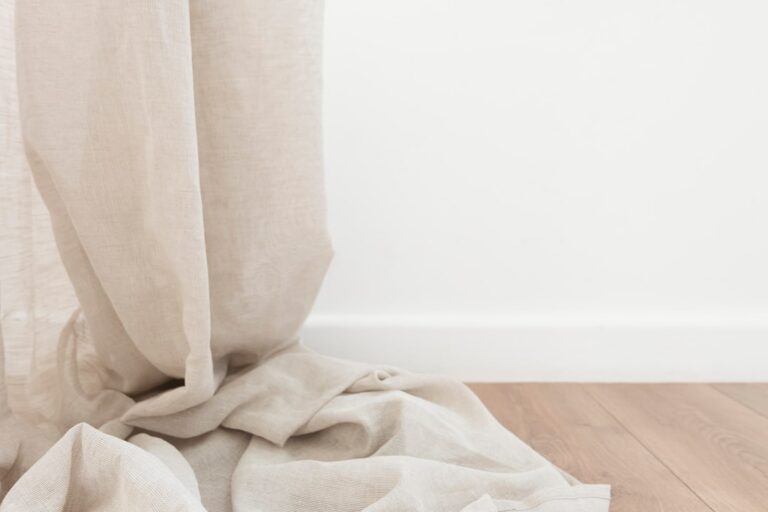
The first panel I tried was a lightweight cotton blend, almost sheer, in a soft oatmeal color. It looked promising on the hanger. Once it went up, the window looked dressed but the room did not feel any calmer or more finished. Light still poured in unevenly, the fabric fluttered every time the front door opened, and by week two it had started to look limp, like a shirt that needed ironing and never got it.
What Weight Actually Does
Curtain weight is not just about how much light a fabric blocks. It changes how the panel hangs, how it folds when pulled open, and how it sits in a room when it is not moving at all. A heavier fabric, something like a mid-weight linen blend or a lined cotton, falls in broader, slower folds. It reads as intentional even when the curtains are just sitting there doing nothing. A light fabric moves more, which sounds appealing until you notice it also looks unsettled most of the time, never quite finding a resting shape.
My second attempt was a mistake in the other direction. I bought a heavy blackout-lined panel for the same window, thinking heavier automatically meant better. It solved the light problem completely, maybe too completely for a room where I wanted morning light to filter in gently rather than get shut out. The panel also dominated the window frame in a way that felt closer to a hotel room than a living room. Two out of three attempts, and I still had not gotten it right.
The third panel was a medium-weight cotton with just enough body to hold a fold but not so much that it read as heavy. That was the one that finally worked, and it was almost an accident that I landed on it.
Drape Is a Different Question From Weight
Weight and drape get talked about as though they are the same thing, but they are not. A fabric can be relatively light and still drape well if it has the right fiber structure, and a heavy fabric can drape stiffly if it is too densely woven. Linen blends tend to drape in soft, irregular folds that look a little different every time you open and close them, which I have come to like. A pure cotton without any linen or viscose mixed in can hang flatter and straighter, which suits a more architectural window but looked wrong against the slightly uneven plaster in my hallway.
I learned to test drape by doing something simple: gathering a swatch or a full panel in one hand and letting it fall, then watching where the folds settle after a few seconds rather than right when I let go. Fabric that keeps shifting and resettling for a while is telling you it will never quite look composed on the rod. Fabric that finds its folds quickly and holds them is the one that will still look good a month from now, not just on the first day.
Matching Weight to the Room, Not Just the Window
The bedroom ended up needing something almost opposite to the living room. Because I wanted the room to feel enclosed and quiet at night, a heavier curtain with a light-blocking lining made sense there, and the slightly stiffer drape did not bother me because the door to that room stays mostly closed anyway, so there is less foot traffic stirring the air. In the living room, where people walk past the window all day, that same stiffness would have looked awkward every time it caught a breeze.
Kitchen windows turned out to be their own category entirely. Anything heavy felt wrong next to a stove and a sink, both for practical reasons and because a busy, damp space does not want fabric that reads as formal. A lighter cotton, almost cafe-curtain weight, ended up being the only thing that did not look out of place once I had tried a heavier option there too and taken it back down within a week.
A Short List of What I Actually Check Now
- How the fabric falls when gathered and released, not just how it looks flat on a table
- Whether the room needs the curtain to move with air flow or stay still most of the day
- How much foot traffic passes near the window, since that affects how often the fabric gets disturbed
- Whether the lining, if there is one, changes the drape as much as the light control
None of this shows up on the fabric label the way fiber content does, so most of it has come from hanging things up, living with them for a couple of weeks, and noticing what bothered me on day twelve rather than day one. That delay matters. A curtain almost always looks fine on the first afternoon. What it looks like after it has been opened and closed forty times is the version that actually matters, and that only shows up with time, not with a swatch in a bright store.