This article may contain affiliate links. If you buy through them, Everyday Nesting may earn a small commission at no extra cost to you. Learn more.
The first lamp I bought for this apartment was a tall floor lamp with a single bulb pointed straight up at the ceiling. I saw it in a photo somewhere, glowing softly in a corner, and assumed it would do the same thing in my living room. It did not. Turned on by itself at night, it made the ceiling glow while the rest of the room, including the couch directly underneath it, stayed dim and slightly gray. I sat under that lamp for a solid month trying to read in it before admitting the light simply was not reaching the page.
The second lamp was my overcorrection. I bought a small, bright table lamp for the side table right next to the couch, the kind with a clear shade that throws light in every direction at once. This one worked for reading, but turning it on alongside the overhead ceiling light and the floor lamp made the whole room feel flat and a little clinical, like a waiting room. Everything was lit evenly, and evenly lit turned out to be its own problem. There were no shadows left to give the room any shape.
What I finally understood about layering
It took a third lamp, a small clip-on reading light I found for the armchair in the corner, before the pattern clicked for me. A room does not need one source of light doing everything. It needs a few different sources doing different, smaller jobs, and it needs some of them to stay off some of the time.
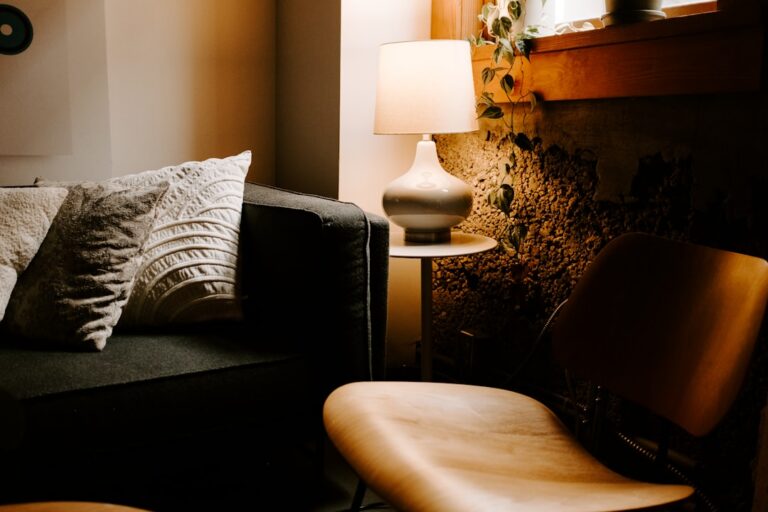
The floor lamp, it turns out, is not useless. It is an ambient lamp, meant to fill the room with a soft general glow, not to light up a book. The table lamp next to the couch is a task lamp, meant for the couch and only the couch, and it looks wrong turned on by itself in an otherwise dark room, because it is too small and too bright for that job. The clip-on light on the armchair is a second task lamp, for one chair and one activity. None of them were ever supposed to work alone.
Three lamps that each do one job beat one lamp trying to do three.
How I actually combine them now
Most evenings I do not turn on the ceiling light at all. I start with the floor lamp alone, which gives the room a low, warm base level of light, enough to walk through without stubbing a toe on the coffee table, but not enough to read by. If I sit down on the couch with a book, the table lamp comes on next to me, and only that one, so the light is concentrated exactly where my eyes need it while the rest of the room stays dim and calm around it. If my partner is in the armchair reading something on their phone at the same time, the clip-on light goes on for them, independent of what I am doing across the room.
What surprised me is how much better the room looks with two or three smaller pools of light and shadow between them, compared to one source lighting every corner evenly. The shadows are not a flaw. They give the room depth it did not have when everything was lit the same amount.
The mistakes worth mentioning
I made two real mistakes getting here that are worth naming so someone else can skip them. The first was assuming a single lamp, however nice, could replace an entire lighting plan. It cannot, no matter how good the lamp is on its own. The second mistake was buying the second lamp too bright and too small in scale for the room, so that turning it on alone felt jarring, like a spotlight rather than a lamp. I ended up swapping that bulb for a lower wattage warm one a few weeks in, which softened it considerably without losing its usefulness for reading.
A rough starting point if you are doing this from scratch
If I were furnishing a living room’s lighting again from nothing, I would start with one ambient source, whether that is a floor lamp, a couple of smaller lamps on either end of the room, or a dimmable overhead fixture. Then I would add one task light wherever there is a chair or couch spot people actually sit and read or work, sized to that one spot rather than the whole room. Only after both of those are in place would I think about anything decorative, like a small accent lamp on a shelf that exists mostly to fill in a dark corner rather than to light anything specific.
None of this happened in one trip to a store. It happened over close to a year, one lamp and one disappointment at a time, until I had enough small failures behind me to see what each one was actually for.